
Rice Mill Project Cost in India: Cost by Capacity, Sheds and Godown
By Bajrang Khaitan · Published
Rice mill project cost in India from Bajrang Khaitan: about ₹2 crore per tonne of capacity, cost by plant size, shed sizes and what is not included.
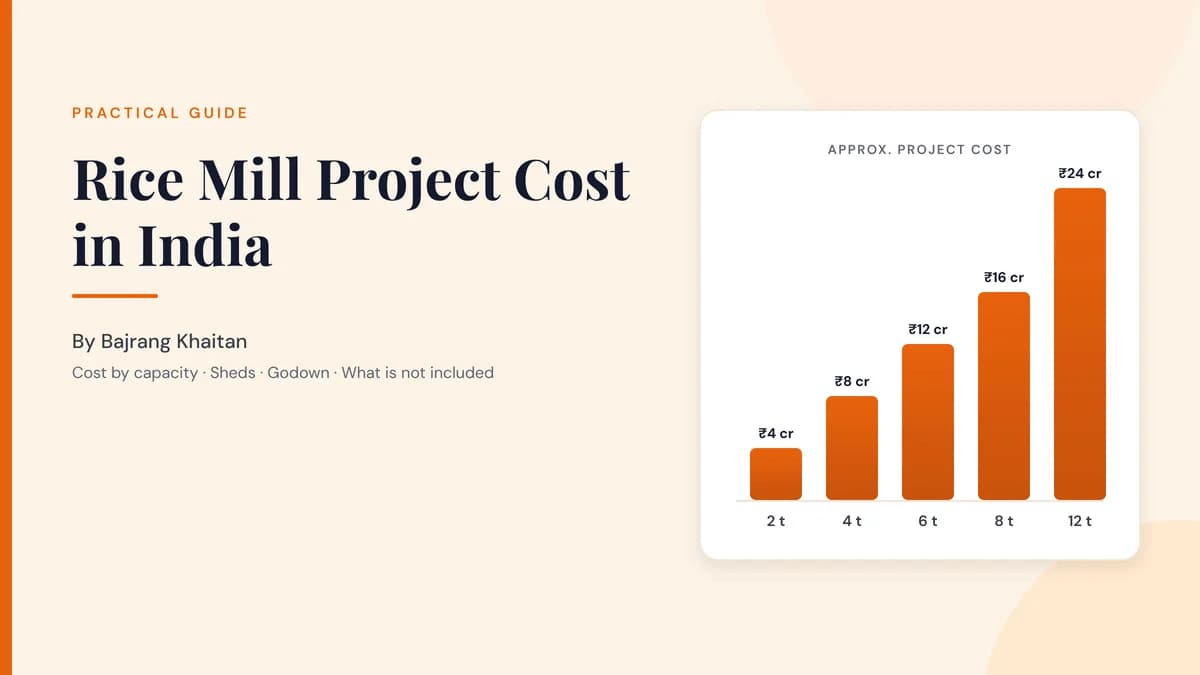
After “how do I start a rice mill?”, the next question every new owner asks me is: “How much will the whole project cost?” This guide gives the rule of thumb I use, what it covers, what it does not cover, and the shed and godown sizes I plan for. These are approximate figures from my experience, not a quotation. Every site is different, so get a project report made for your own capacity and location before you commit money.
The rule of thumb: about ₹2 crore per tonne
For a rice mill process plant, the cost comes to approximately ₹2 crore per tonne of plant capacity. I use the same figure for 2- and 4-tonne plants and for 6-, 8- and 12-tonne plants. This figure includes GST.
There is not much cost difference between an arwa (raw) plant and a boiled (parboiled) plant. The boiled plant needs a boiler and a dryer, and the arwa plant does not.
Rice mill project cost by capacity
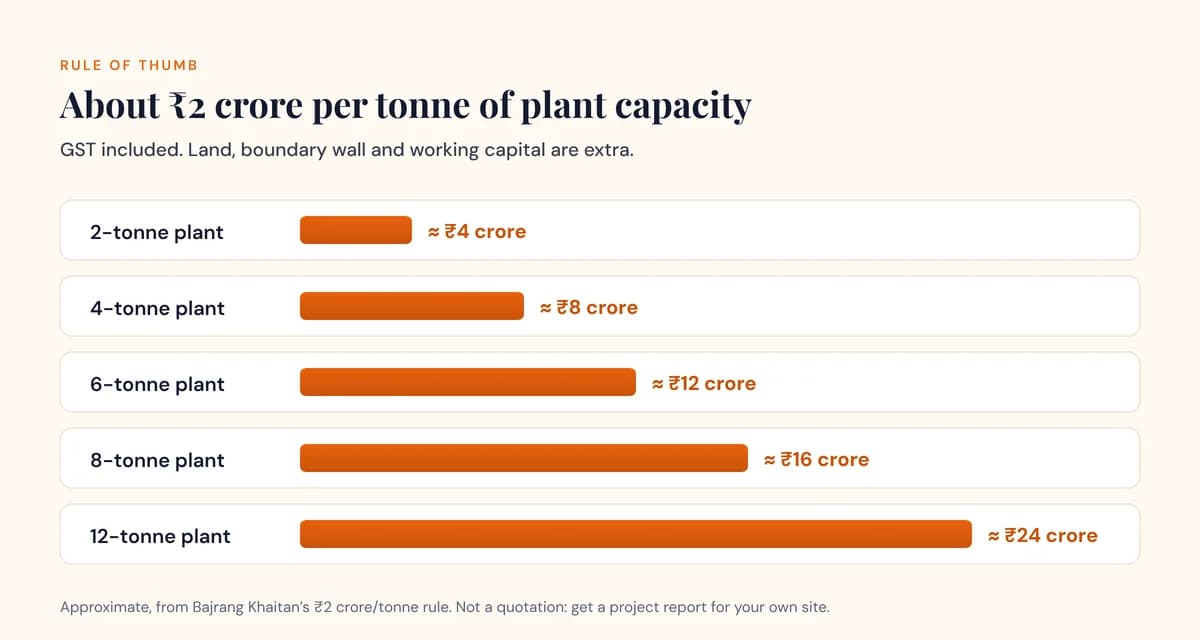
Using the ₹2 crore per tonne rule, the plant cost works out roughly like this:
- 2-tonne plant: about ₹4 crore
- 4-tonne plant: about ₹8 crore
- 6-tonne plant: about ₹12 crore
- 8-tonne plant: about ₹16 crore
- 12-tonne plant: about ₹24 crore
Treat these as a starting point for your planning and your talks with the bank. The final figure depends on your site, the civil work and the machinery you choose.
What is not included
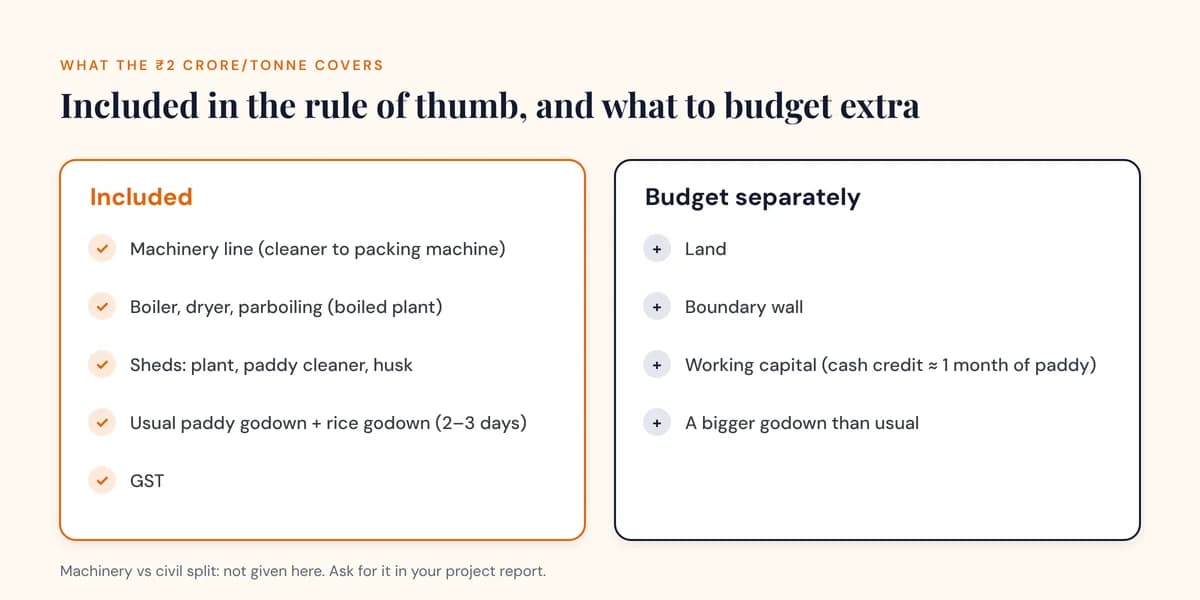
Three things are not in the ₹2 crore per tonne figure, and you must budget for them separately:
- Land. The land cost is extra. For a 2- to 4-tonne plant, roughly 3 acres is enough; a larger plant needs more. See how much land you need in my guide on starting a rice mill.
- Boundary wall. The boundary wall around the land is also extra. Build it right after you buy the land, for security.
- Working capital. You need separate money for working capital. Plan a cash-credit limit of roughly one month’s stock of paddy.
The usual godowns are part of the plant cost. If you want a larger godown than the usual one, that will cost extra.
Shed sizes by plant capacity
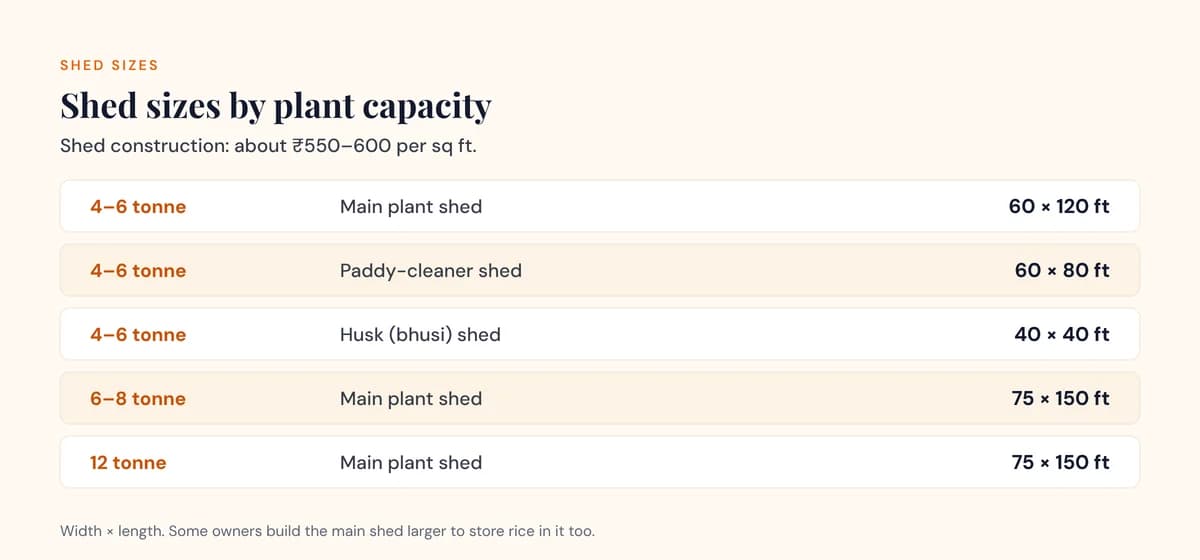
You will need sheds for the plant, for the paddy-cleaner machine and for husk (bhusi), and on a boiled plant for the boiler as well. These are the sizes I plan for (width × length):
- 4- to 6-tonne plant: main plant shed about 60 × 120 ft; paddy-cleaner shed about 60 × 80 ft; husk shed about 40 × 40 ft, which is very good.
- 6- to 8-tonne plant: the main shed becomes bigger, about 75 × 150 ft.
- 12-tonne plant: main shed about 75 × 150 ft.
Shed construction costs approximately ₹550 to 600 per square foot, depending on how much shed you build. Some people build the main shed larger so they can also store rice in it.
How big should the paddy godown be?
I plan the paddy godown for about 7 to 10 days of paddy stock, but only when paddy arrives every day, for example in custom milling or with a steady intake.
If the mill buys its own paddy, plan for 15 to 30 days or more. Many commercial project plans use 30 to 60 days, and large integrated mills use silos for months of stock; the TNCSC 200 TPD mill project report plans paddy silos for about 120 days of intake.
For space, 1,000 tonnes of bagged paddy needs roughly 7,000 sq ft including aisles, going by standard godown layouts (for example IS 16144).
Keep a separate rice godown that can hold 2 to 3 days of rice production.
Project report and bank loan
Once the land is bought and the boundary wall is up, get quotations for the machinery from all the companies and start preparing the project report at the same time. When the project report is ready, apply to the bank for the loan. After the loan is sanctioned, pay the advance to the companies, get the machine drawings and layout, and start the work through an engineer. The full sequence is in my guide on how to start a rice mill in India.
Ask about subsidy too: there is capital subsidy, interest subsidy and some subsidy on power. Scheme names, rates and eligibility depend on your state and change over time, so your project report and your bank are the right place to work out what you can claim.
How I can help
I get project reports made, help with machinery selection and with the setup, and can provide manpower for running the mill. If you are planning a new mill, book a free 20-minute intro call and we can talk through your capacity and budget. You can also write to me, start a longer consultancy discussion or ask for a mill visit.
Frequently asked questions
What is the cost of a rice mill project in India?
As a rule of thumb, about ₹2 crore per tonne of plant capacity, including GST. That is roughly ₹4 crore for a 2-tonne plant, ₹8 crore for 4 tonnes, ₹12 crore for 6 tonnes, ₹16 crore for 8 tonnes and ₹24 crore for 12 tonnes. It is not a quotation; get a project report for your own site.
Does the ₹2 crore per tonne include land?
No. Land and the boundary wall are not included, and working capital needs separate money. GST is included.
What shed size does a 4 to 6 tonne rice mill need?
About 60 × 120 ft for the main plant shed, about 60 × 80 ft for the paddy-cleaner shed and about 40 × 40 ft for the husk shed. For 6 to 8 tonnes, and for a 12-tonne plant, the main shed is about 75 × 150 ft.
How much does a rice mill shed cost per square foot?
Approximately ₹550 to 600 per square foot, depending on how much shed you build.
How big should a paddy godown be?
Plan for about 7 to 10 days of paddy stock only if paddy arrives every day (custom milling or steady intake). If the mill buys its own paddy, plan for 15 to 30 days or more. About 1,000 tonnes of bagged paddy needs roughly 7,000 square feet including aisles. Keep a rice godown for 2 to 3 days of production.